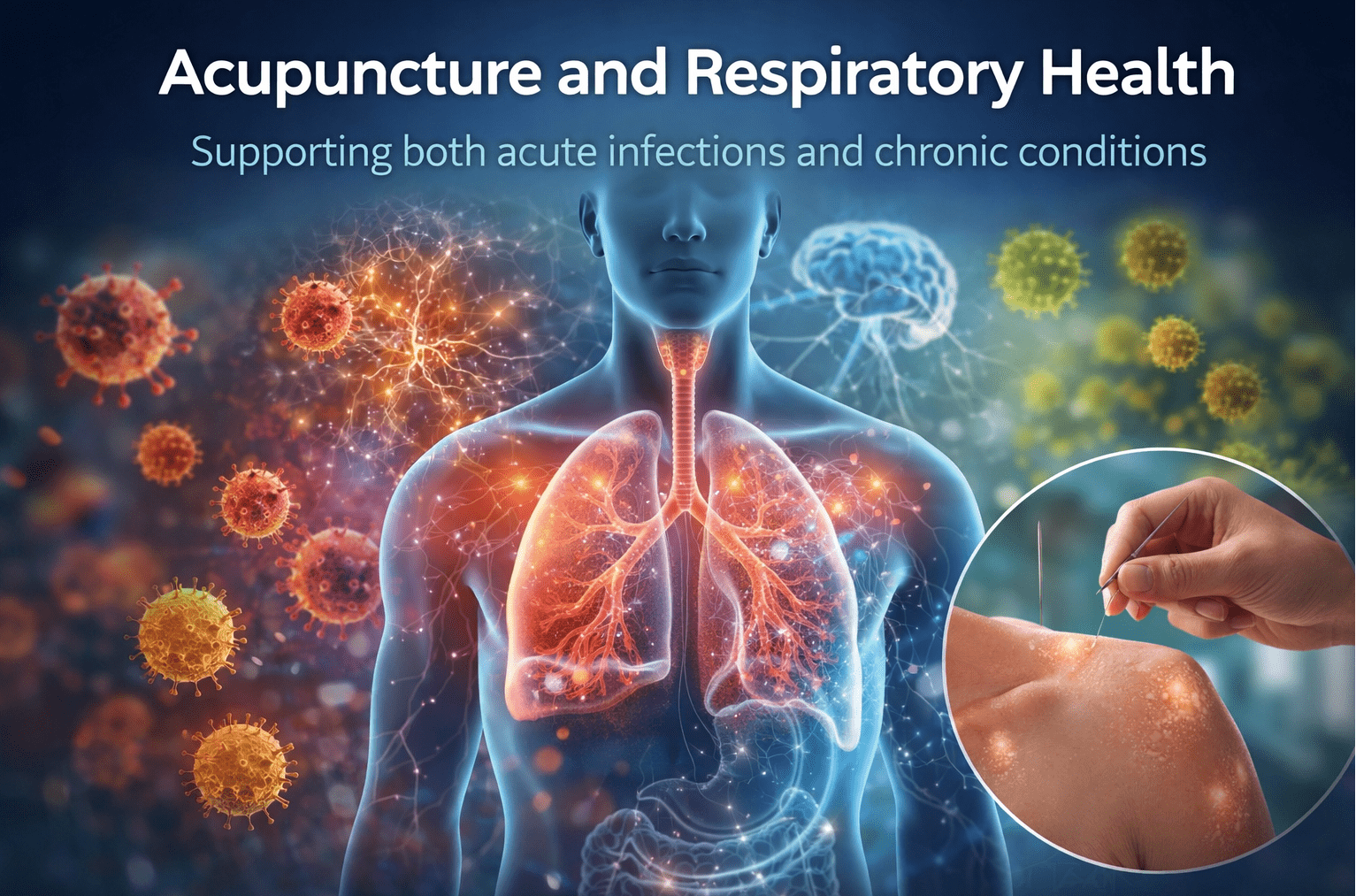
Acupuncture and Respiratory Health
Supporting both acute infections and chronic conditions
Over the past decade, acupuncture has gained increasing attention as a safe and effective treatment option across a wide range of conditions. Its use has expanded not only in traditional settings, but also within integrative and evidence-informed healthcare models. While many patients report meaningful improvements, an important question remains: what does the research actually say? To explore this, we have looked at three recent papers examining how acupuncture influences the immune system and its potential role in conditions driven by inflammation and immune dysregulation.
Respiratory conditions, whether acute such as colds and infections, or chronic such as asthma, allergies and post viral syndromes, often share a common underlying driver. At the centre of both is immune dysregulation and inflammation. The research across the three papers highlights that acupuncture may play a meaningful role here, not by simply stimulating or suppressing the immune system, but by helping to restore balance within it.
A key concept discussed is immune homeostasis. This refers to the body’s ability to maintain a balanced immune response that is strong enough to defend against pathogens, but controlled enough to avoid excessive inflammation or tissue damage. When this balance is lost, disease can develop. If the immune system is underactive, infections may persist or recur. If it is overactive, chronic inflammation and allergic responses can emerge. Acupuncture has been shown to regulate the immune system in a bidirectional way, meaning it can enhance immune function when it is deficient and suppress it when it is excessive, helping to restore this equilibrium (Liu et al., 2024).
Rather than acting directly on the lungs, acupuncture works through the neuroendocrine immune network. Stimulation of specific acupuncture points activates pathways involving the autonomic nervous system and the hypothalamic pituitary adrenal axis. This includes reflex pathways such as the vagal adrenal axis, which has been shown to reduce systemic inflammation by lowering pro inflammatory cytokines like interleukin 6 and tumour necrosis factor alpha (Liu et al., 2024; Wang et al., 2023). Through these mechanisms, acupuncture influences how the body responds to infection, regulates inflammation and supports recovery.
In acute respiratory conditions, the immune system must respond quickly and effectively to clear pathogens. At the same time, excessive inflammation can worsen symptoms and delay recovery. Acupuncture appears to support this balance by enhancing innate immune activity while moderating inflammatory responses. Research shows that acupuncture can increase the activity of natural killer cells, which are important for identifying and destroying virus infected cells (Liu et al., 2024; Wang et al., 2023). It also influences neutrophils, which are key players in early immune defence, helping regulate their recruitment and activity during acute inflammatory states (Wang et al., 2023). Importantly, acupuncture has been shown to reduce excessive inflammatory signalling through neural pathways, supporting a more efficient and controlled immune response (Liu et al., 2024).
Chronic respiratory conditions present a different challenge. These states are often driven by ongoing immune imbalance rather than active infection. Conditions such as allergic airway disease or chronic inflammation involve persistent dysregulation of immune pathways. Acupuncture has been shown to help rebalance these pathways, including restoring equilibrium between key immune axes such as Th1 and Th2 and Th17 and regulatory T cells (Liu et al., 2024). This is particularly relevant in allergic and inflammatory respiratory conditions where immune responses are often skewed.
At a cellular level, acupuncture influences several important immune cells involved in chronic inflammation and repair. It regulates macrophage activity, helping shift them from a pro inflammatory state toward a tissue repair and anti inflammatory phenotype (Wang et al., 2023). It also modulates mast cells, which play a central role in allergic responses, contributing to both local and systemic immune regulation (Wang et al., 2023). These effects support a reduction in chronic inflammation and promote tissue recovery over time.
Another important aspect highlighted across the research is the role of the nervous system in immune regulation. Acupuncture activates both parasympathetic and sympathetic pathways, allowing it to influence immune responses depending on the state of the body. Activation of the vagus nerve contributes to anti inflammatory effects, while sympathetic pathways can modulate immune activity in a context dependent way (Liu et al., 2024). This helps explain why acupuncture is often beneficial in individuals whose respiratory symptoms are influenced by stress or nervous system dysregulation.
In addition to these regulatory effects, acupuncture has also been shown to support overall immune resilience. Clinical and experimental studies demonstrate improvements in adaptive immune markers, including increases in T lymphocyte subsets and natural killer cell activity, which are important for long term immune surveillance and recovery (Wang et al., 2025). This is particularly relevant in patients with chronic or recurrent respiratory conditions where immune function may be compromised.
What makes acupuncture particularly unique is its ability to regulate rather than override the immune system. Many conventional therapies act in a single direction, either stimulating or suppressing immune activity, which can lead to unwanted side effects. In contrast, acupuncture appears to work by restoring balance within the system, with a strong safety profile and minimal adverse effects reported in the literature (Wang et al., 2023).
Taken together, the evidence suggests that acupuncture offers a systems based approach to respiratory health. By supporting immune homeostasis, regulating inflammation and engaging the nervous system, it may assist in both the management of acute infections and the longer term regulation of chronic respiratory conditions. This makes it a valuable tool not only for symptom relief, but for improving resilience and recovery over time.
References
Liu, F., Wang, Y., Lyu, K., Du, X., Zhou, M., Shi, J., Na, R., Guo, Y., Wang, G., Xu, W., & Zheng, T. (2024). Acupuncture and its ability to restore and maintain immune homeostasis. QJM: An International Journal of Medicine, 117(3), 167–176. https://doi.org/10.1093/qjmed/hcad134
Wang, M., Liu, W., Ge, J., & Liu, S. (2023). The immunomodulatory mechanisms for acupuncture practice. Frontiers in Immunology, 14, 1147718. https://doi.org/10.3389/fimmu.2023.1147718
Wang, Y., Sui, B., Zhang, Y., Fang, L., Xie, Y., Fang, Y., & Wang, R. (2025). Effect of acupuncture and moxibustion on the immune function of patients with malignant tumors: A systematic review and meta-analysis. Frontiers in Immunology, 16, 1583522. https://doi.org/10.3389/fimmu.2025.1583522