Understanding the Return of Health Rebates for Naturopathy
Private Health Rebates for Naturopathy Are Back… But There’s a Catch
There’s been some quiet but important movement in Australian healthcare, and if you value naturopathy or Western herbal medicine, it’s worth paying attention.
Private health insurance rebates for naturopathy and several other natural therapies are being reinstated across Australia. On the surface, that sounds simple. In reality, it reflects years of policy shifts, debate around evidence, and changing perspectives on what constitutes effective healthcare.
To understand why this matters, it helps to look at how we got here.
Back in 2019, the Australian Government removed private health insurance rebates for 16 natural therapies, including naturopathy and Western herbal medicine. This followed an earlier review that concluded there was “insufficient evidence” to support their clinical effectiveness. While that phrase sounds definitive, it was widely debated within the healthcare community, particularly given how evidence was defined, selected, and interpreted.
Importantly, this decision did not occur in isolation. It came at a time when natural therapies were increasingly under scrutiny from groups advocating for a narrower interpretation of evidence-based medicine. Some of these groups had already turned their attention to natural medicine education within universities, questioning academic standards and scientific validity. In several cases, the evidence put forward in these campaigns was itself criticised by academic institutions and stakeholders as being methodologically weak or overly selective, and was not adopted by universities in the way proponents had intended. Over time, this scrutiny extended beyond education and into funding structures, including private health insurance.
The removal of rebates had real-world consequences. It didn’t stop people from seeking naturopathic care, but it did make access more difficult. For many Australians, particularly those managing chronic or complex conditions, it meant higher out-of-pocket costs and fewer options within their existing health cover.
Despite this, demand for naturopathy and Western herbal medicine remained strong. In many cases, it continued to grow, driven by a desire for more personalised, preventative, and integrative approaches to health.
Fast forward to the present, and the landscape is shifting.
The Natural Therapies Review 2024 revisited the evidence with updated methodologies and a broader scope. Rather than asking a narrow question of whether a therapy meets a specific biomedical standard in isolation, the review considered how these therapies are used in practice, particularly in relation to chronic disease, prevention, and whole-person care.
This time, the findings were different.
The review concluded that there is supportive evidence for several therapies, including naturopathy and Western herbal medicine. These therapies were recognised for their role in supporting health outcomes across a range of contexts, particularly where lifestyle, nutrition, and long-term management are central to care.
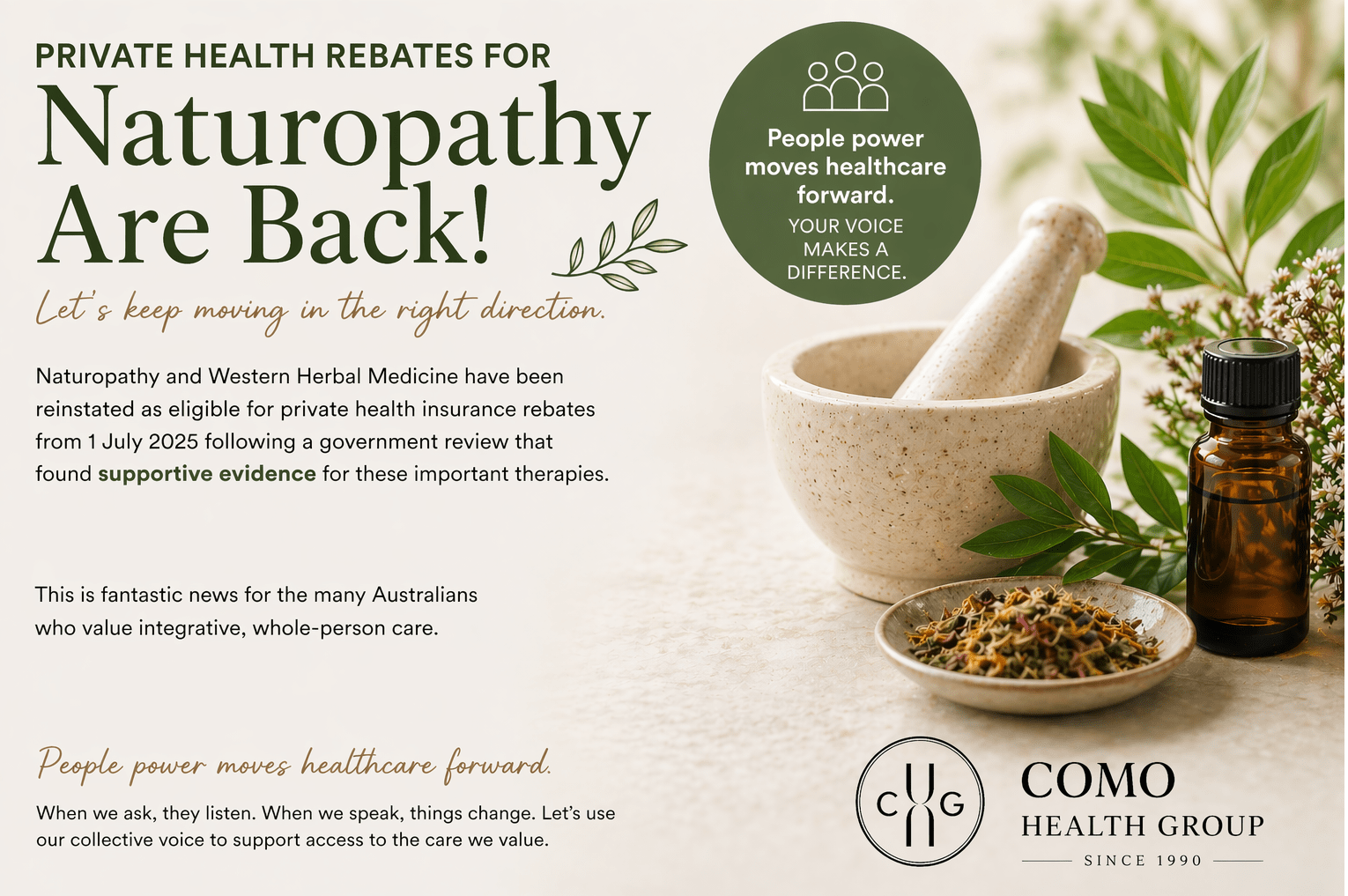
As a result, seven natural therapies, including naturopathy and Western herbal medicine, have now been reinstated as eligible for private health insurance rebates from July 2025.
This is more than just a policy reversal. It reflects a broader shift in how healthcare is being understood. There is increasing recognition that health is not purely the absence of disease, and that effective care often requires addressing multiple layers at once, including biochemical, structural, and emotional factors.
That said, there is an important nuance.
Just because rebates are now permitted does not mean they are automatically available.
Private health insurers still make their own decisions about what they include in their policies. This means each fund can choose whether to offer rebates for naturopathy, when to introduce them, and what level of coverage to provide. As a result, we are currently in a transition phase where availability will vary between providers.
For patients, this creates both an opportunity and a responsibility.
If you have private health insurance, now is the time to ask questions. Are naturopathy rebates available under your policy? If not, when are they expected to be introduced? And if there are no plans to include them, why not?
These conversations matter. Policy changes set the framework, but consumer demand often determines how quickly and fully those changes are implemented. When enough people ask for access to the care they value, insurers take notice.
This is how systems evolve. Not just from the top down, but from the ground up.
At Como Health Group, our approach has always been to integrate naturopathy and acupuncture with other complementary therapies, including myotherapy, chiropractic care, and psychotherapy. This multi-modality model allows us to support patients across the full spectrum of health, from acute concerns to long-term wellbeing.
We see every day how this kind of care can make a meaningful difference. The reinstatement of rebates is a step toward improving access, but there is still work to be done to ensure that access is consistent and equitable.
If naturopathy has been part of your health journey, or if you are curious about incorporating a more integrative approach, now is the time to engage with your provider and be part of that shift.
Because when people advocate for the care they value, healthcare moves forward.
Yours in good health,
Como Health Group
Natural Science at Work